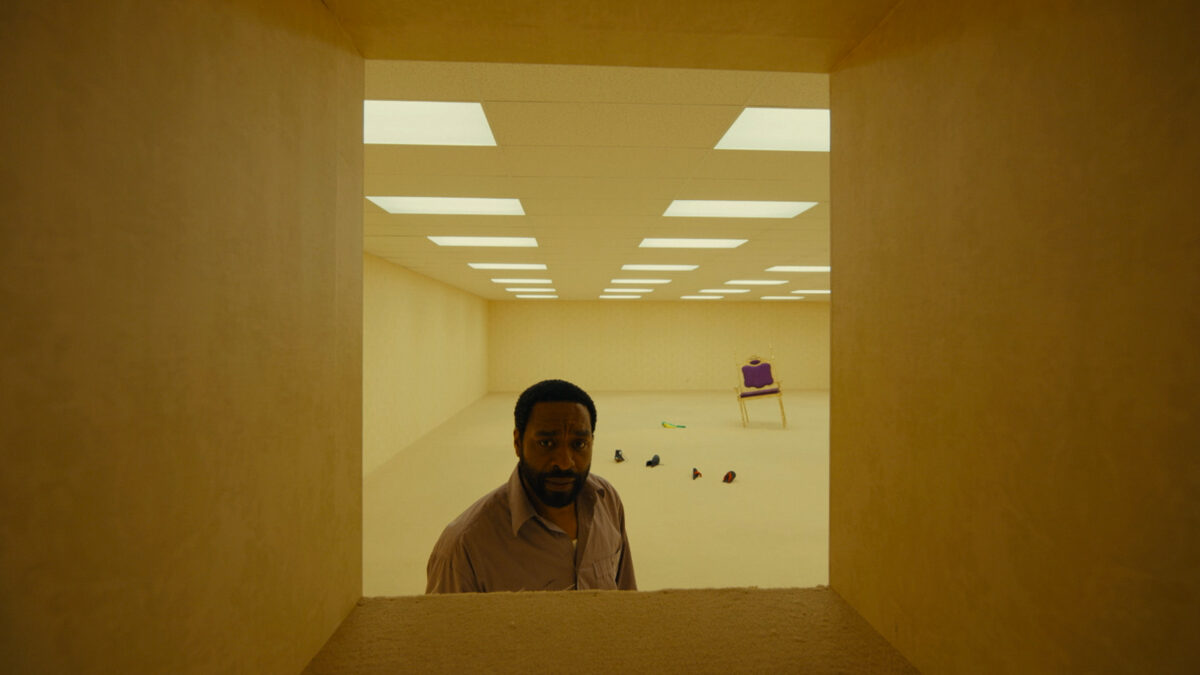
backrooms (2026)
Welp. This is it. I officially feel old.
That’s not true, I felt old watching The Minecraft Movie in theaters. Hell, I remember when Minecraft was in beta testing and FREE. Sorry, it’s too early for a tangent or diatribe.
Backrooms follows an alcoholic discount furniture warehouse owner/operator Clark (Chiwetel Ejiofor), who has been kicked out of his house by his wife and is relegated to sleeping inside his store on his showroom model beds.
It’s a period piece, taking place in the 90s. There’s no real reason for it to be grounded in that timeframe other than it seems Kane Parsons likes the aesthetic of shot-on-video found-footage. Aside from the camcorder and a stray “End Apartheid Now” t-shirt, there’s nothing that really roots this in the 90s. This could have taken place in any era (a 1930s version of Backrooms would actually be pretty killer).
Early on, we’re introduced to Mary (Renate Reinsve), Clark’s therapist, who is helping him move on from his recent separation, where he came home late and reeking of beer, leaving his wife no other option than to kick him out. I was left questioning how effective Mary was as a therapist. We don’t know how many sessions Clarke has been to, he’s still very much deep in denial and entitlement, “…She kicked my out of my house. I paid for it.”
One night, while drinking Jim Beam in a showroom bed, the power goes out in the warehouse. Clarke goes downstairs to investigate the issue and discovers a green-walled, fluorescent-laden labrynth that almost infinitely expands deep below his store. Undeterred by the liminal space and furniture that ‘doesn’t look quite right’, he walks deeper into the hidden space, until he discovers he’s being followed and is chased through a door that reminded me of a certain Simpsons episode:
I choose to believe that scene in Backrooms is a direct reference to this Simpsons clip. It’s just too similar to be coincidence.
Clarke (being an architect) brings his sketch of the backrooms to… his therapist…
incoming diatribe
Why did the architect become the job for TV and film characters? Is it because no one really knows what an architect does or what their day-to-day looks like? Is it because they have a ton of free time? Do they have a ton of downtime? A large influx of cash for drafting up another Starbucks? Just from memory, I decided to list all of the TV and film architects I could come up with
- The Brady Bunch – Mike Brady
- Seinfeld – George Costanza (not technically, but he always wanted to be one)
- Death Wish – Paul Kersey
- The Brutalist – Laszlo Toth
- Inception – Leo and Elliot Page
- Click – Adam Sandler’s character
- The Fountainhead – Gary Cooper’s character
- Megalopolis – Adam Driver’s character
- Saw – I believe John Kramer is a famed city planner, which is pretty much an architect
- The Matrix: Reloaded – They’re searching for an architect in that one
- How I Met Your Mother – Ted
- 500 Days of Summer – JGL
- 3 Men and a Baby – Tom Selleck
- The Lake House – Keanu Reeves
And I’m sure the list goes on and on… and on and on…
But do you ever see the architects in any of these films and TV shows drafting buildings? Absolutely not. Because no one knows exactly what an architect does, and if they do know, it’s probably the most boring thing on earth. But you can be damn sure that you’ll see a drafting table propped up in a corner of their office, or they’ll get a call sitting at their cool angled drafting table, holding a protractor or a short nubby pencil looking over blueprints. If you’re lucky, you’ll even see them with their little tube with the blueprints rolled up inside.
This movie? All you get is a little napkin that Clark scribbled all over. No wonder he runs a failing furniture business.
end diatribe
So, why does Clark bring his sketches to his therapist? Because he’s alienated what few people he has in his life not on his payroll. Mary is obviously hesitant to believe an entitled, lonely drunk; so Clark goes off to the backrooms for proof, bringing along his two employees, Bobby (Finn Bennett) and Kat (Lukita Maxwell). They get lost in the labyrinth, and Mary follows the signs to the backrooms and musters up the courage to find Clark.
What I’ve described so far is unfortunately the majority of the film. I personally thought the third act was the best part. It’s when the story actually gets going, and we realize our protagonist isn’t Clark, but Mary. We begin to learn about the backrooms, what they are, what their inhabitants are, and who set up all those closed-circuit cameras placed strategically around the liminal space.
And then, the film ends; abruptly. Randomly.
Don’t get me wrong, I love an ambiguous ending to a film (and no, I’m not talking about Inception. I never understood the argument for an ambiguous ending. It’s clear as day.), but the ending to Backrooms was just underbaked. It’s a perfect example of ‘style over substance’ there’s interesting imagery throughout, but I don’t really care for either of our main characters, because they seemingly don’t have any life or goals outside of their sad careers. Luckily, those two characters are played by seasoned performers oozing charisma.
The film references a few really interesting ideas. At one point, Clark describes what the backrooms does, it creates “a copy of a copy” and after a while, it becomes so distorted it doesn’t look like anything recognizable. This had some really interesting implications.
There’s a theory that as you remember specific life events more and more, your brain fills in missing pieces incorrectly. It could be as simple as the color of the walls in the room, or it could be what shirt you were wearing, who you were with, what their faces looked like. And the more you attempt to remember that specific moment in time, the more incorrect it becomes, before it’s something completely different.
Another interpretation could be the obvious allusion to AI. There’s AI models that are learning from other AI learning models, creating a literal copy of a copy, until eventually Google AI Summary tells you that parking is always free on weekends and you park there thinking it’s free and get back after a long day out to find a parking ticket on your windshield, you ask the meter maid and they say parking hasn’t been free since 2012, and you go back to google and find the page the AI Summary was referencing was an outdated city page from 2012 and you complain to Google about it and get left on read!
Sorry about that…
There were so many avenues Parsons could’ve gone down to investigate memories and Artificial Intelligence, and he decided to end the film just as something interesting was happening. After the film ended, my friend Johnny turned to me and said, “You look disappointed.” He was right.
I’m not mad, Kane. Just disappointed.
And maybe this in-depth journey of discovery I’m looking for is in one of those EIGHT HOUR lore videos on YouTube, or it’s in Kane Parsons’ follow-up videos to his original short. I’ll never know, because it’s just not in the movie.
rating: 2.5/5 (not for me)
who should watch this film?
- Teens that want to see something familiar, but doesn’t make them think
- Fans of meticulous wallpapering
- Architects (they’re back in films!)
- Therapists (so they can feel good about themselves)
- Stoners
- Conspiracy Theorists
P.S. The commitment from the set design team to actually create 30,000 sq. ft. of actual, real sets. That in itself garnered my attention and the majority of the rating. I’m loving the return to practical effects and sets.

